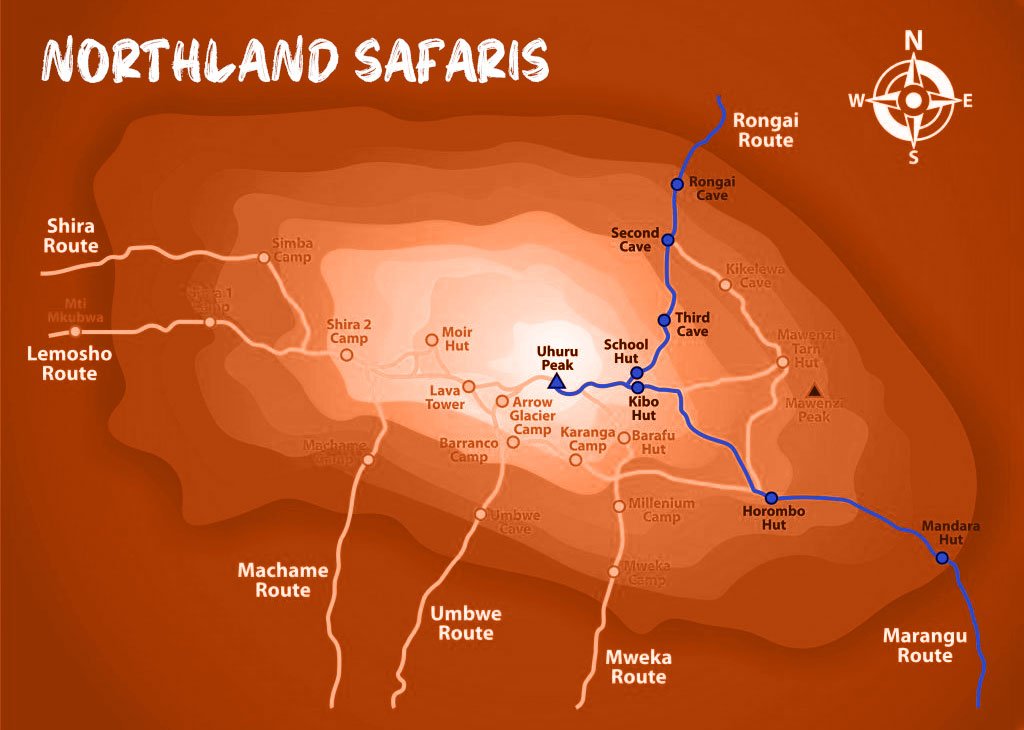


Rongai Route
The Rongai route is the only route that approaches Kilimanjaro from the north, close to the Kenyan border. Though gaining popularity amongst climbers, this route still experiences low crowds.
Rongai has a more gradual slope than the mountain’s other routes. It is the preferred route for those looking for an alternative to the popular Marangu route, for those who would like a more remote hike, and for those who are climbing during the rainy season (the north side receives less precipitation).
Rongai is a moderately difficult route and is highly recommended, especially for those with less backpacking experience. Although the scenery is not as varied as the western routes, Rongai makes up for this by passing through true wilderness areas for nearly the entire way. Descent is made via the Marangu route.
Northland Safaris offers Rongai as a 7-day group climb or as a 6-to-8-day private climb.
The 7-day Rongai route is the standard itinerary and is described in detail below.
The 6-day Rongai variation does not have an acclimatization day on day 4 at Mawenzi Tarn.
The 8-day Rongai “daytime summit” route shortens the summit day by beginning the summit bid in the daytime and returning and staying at Kibo Hut (instead of going to Horombo Hut). This variation eliminates the midnight summit attempt, which is typically very cold and windy, but uses an additional day to complete the descent.
How Long is the Rongai Route?
The distance of the Rongai route is approximately 81 km or 50 miles.
How Many Days Does It Take to Climb Kilimanjaro on the Rongai Route?
The Rongai route has several variations and can be completed in 6 to 8 days. The standard itinerary is the preferred variation which requires 7 days.
How Hard is it to Climb Kilimanjaro on the Rongai Route?
The Rongai route is considered a moderate route. The elevation gain is gradual and not strenuous. However, because it is one of Kilimanjaro’s shorter routes, some climbers may succumb to altitude sickness due to its less-than-ideal route profile.
What is the Success Rate of Climbing Kilimanjaro on the Rongai Route?
For all operators combined, it is estimated that the 6-day Rongai route has a success rate of approximately 50% and the 7-day Rongai route has a success rate of about 70%. Our 6-day Rongai route has a success rate of approximately 70-75% and our 7- and 8-day Rongai route has a success rate of approximately 85-90%.
How Much Does It Cost to Climb Kilimanjaro on the Rongai Route?
The cost to climb the Rongai route depends on the number of days. Our current pricing for group climbs on the 7-day Rongai route is $3,050 per person.
Included/Excluded
- Park fees (for non-residents)
- All activities (unless labeled as optional)
- All accommodation as stated in the itinerary
- A professional driver/guide
- All transportation (unless labeled as optional)
- All Taxes/VAT
- Roundtrip airport transfer
- All Meals (as specified in the day-by-day section)
- Drinking water on all days
- Park fees (for non-residents)
- Additional accommodation before and at the end of the tour
- Tips (tipping guideline US$20.00 pp per day)
- Personal items (souvenirs, travel insurance, visa fees, etc.)
- Government imposed increase of taxes and/or park fees
- Alcohol drinks
Tour Plan
- Elevation: 6,398 ft to 9,300 ft
- Hiking Time: 3-4 hours
- Distance: 8 km | 5 miles
- Habitat: Rain Forest
We drive from Moshi to Marangu Gate for permits before taking a short transfer to the Rongai Gate trailhead. The path winds through corn and potato fields and then climbs gently through the forest which is home to a variety of wildlife, including the black and white colobus monkey.
Rongai Cave to Second Cave
- Elevation: 9,300 ft to 11,300 ft
- Hiking Time: 3-4 hours
- Distance: 6 km | 4 miles
- Habitat: Heath
Second Cave to Kikelewa Cave
- Elevation: 11,300 ft to 11,811 ft
- Hiking Time: 3-4 hours
- Distance: 6 km | 4 miles
- Habitat: Heath
We begin this morning with a steady incline up to Second Cave. We continue trekking though moorland, leaving the main trail for a smaller path towards the jagged peaks of Mawenzi, before finally arriving at Kikelewa Cave for the night.
- Elevation: 11,811 ft to 14,160 ft
- Hiking Time: 3-4 hours
- Distance: 5 km | 3 miles
- Habitat: Alpine Desert
The hike today is short and steep up a grassy slope. Views of the wilderness area are stunning. As we exit the heath zone and emerge into the Alpine Desert zone, the landscape changes dramatically. Our camp is situated beneath the jagged spires of Mawenzi, at Mawenzi Tarn. The remainder of the day can be spent relaxing or exploring the area.
Mawenzi Tarn to Mawenzi Ridge
- Elevation: 14,160 ft -14,400 ft
- Hiking Time: 1-2 hours
- Distance: 2 km | 1 miles
- Habitat: Alpine Desert
Mawenzi Ridge to Mawenzi Tarn
- Elevation: 14,400 ft -14,160 ft
- Hiking Time: 1-2 hours
- Distance: 2 km | 1 miles
- Habitat: Alpine Desert
This is an extra day meant for acclimatization and can be spent day hiking on Mawenzi Ridge. The unique landscape offers motivating views of Kibo and Mawenzi. After spending a few moments exploring the area we headed back to Mawenzi Tarn for camp.
- Elevation: 14,160 ft to 15,430 ft
- Hiking Time: 5-6 hours
- Distance: 8 km | 5 miles
- Habitat: Alpine Desert
We climb gradually, then cross the lunar desert of the “Saddle” between Mawenzi and Kibo. Our camp, Kibo Hut, sits at the bottom of the Kibo crater wall. Once here we rest, enjoy an early dinner to prepare for the summit day.
School Hut to Uhuru Peak
- Elevation: 15,430 ft to 19,341 ft
- Hiking Time: 7-9 hours
- Distance: 6 km | 4 miles
- Habitat: Arctic
Uhuru Peak to Horombo Hut
- Elevation: 19,341 ft to 12,205 ft
- Hiking Time: 4-6 hours
- Distance: 16 km | 10 miles
- Habitat: Heath
Very early in the morning (around midnight), we begin our push to the summit. This is the most mentally and physically challenging portion of the trek. The wind and cold at this elevation and time of day can be extreme. We ascend in the darkness for several hours while taking frequent, but short, breaks. At Gilman’s point (18,600 ft), you will be rewarded with the most magnificent sunrise you are ever likely to see coming over Mawenzi Peak. Finally, we arrive at Uhuru Peak- the highest point on Mount Kilimanjaro and the continent of Africa.
After spending a few moments taking in the plains of Africa and your accomplishment, we descend to Horombo Hut. Later in the evening, we enjoy our last dinner on the mountain and have a well-earned sleep.
- Elevation: 12,205 ft to 6,046 ft
- Hiking Time: 7-9 hours
- Distance: 20 km | 12 miles
- Habitat: Rain Forest
On our last day, we had a long trek, mostly downhill through the tropical rainforest. Once at the park headquarters at Marangu gate, we collect our summit certificates. A vehicle will meet us here and drive us back to the hotel in Moshi or Arusha.
Tour Map